Colorado’s Multilingual Labor & Workforce Needs
For years now, Colorado’s K-12 and postsecondary language education and workforce systems have produced the multilingual talent the state relies on for several in-demand industries.
In Colorado, multilingual workers operate as the bridge between service and delivery, between institutions and their beneficiaries, and between systems and distinct populations of their constituents.
Affirmed by state workforce data, multilingual workers serve a critical role in meeting Colorado’s distinct linguistic needs. At The Multilingual Project (TMP), we advocate for a future where this value is reflected through unique means of compensation, so that:
- K-12 and postsecondary students have more incentives to pursue and complete a language education;
- Employers have more incentives to hire and upskill multilingual staff; and
- Multilingual labor conditions are improved and aligned with the value that workers bring across industries.
How Do We Measure Proficiency?
The American Council on the Teaching of Foreign Languages (ACTFL) offers a trusted understanding of how to measure foreign language proficiency. Segmented across five levels from Novice, to Intermediate, Advanced, Superior, and Distinguished, with sub-levels (Low, Mid, and High) between Novice to Advanced (e.g., Novice-Low, Intermediate-Mid, etc). Below is a set of images to understand proficiency levels visually.
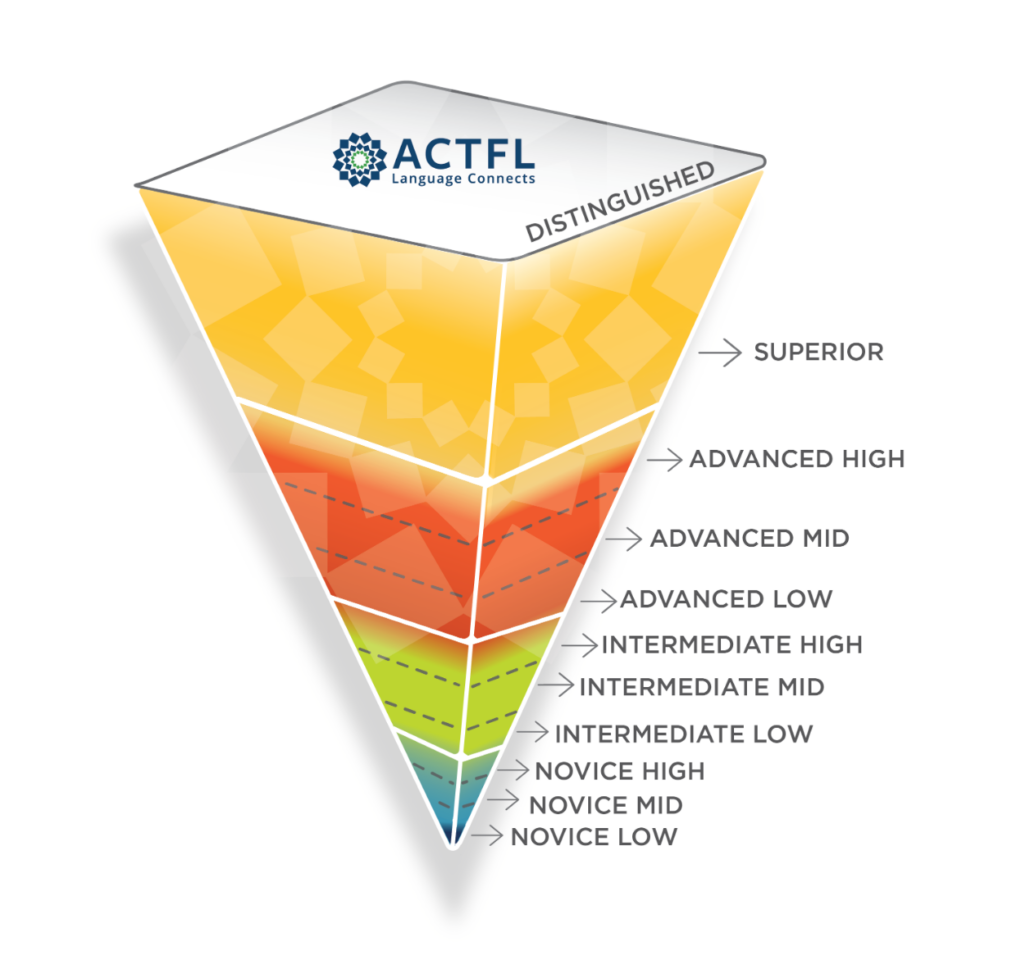
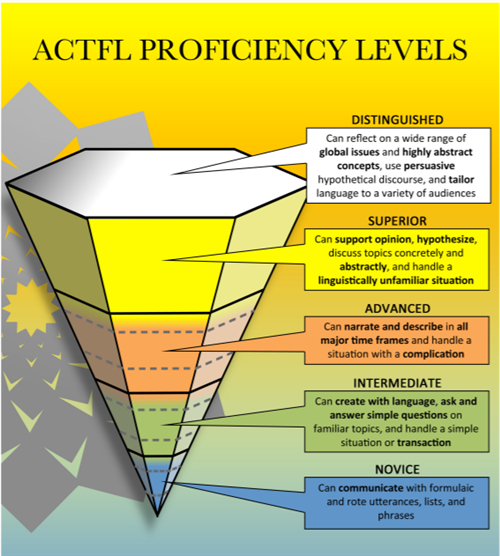
As learners progress through each proficiency level, they gain increasingly unique language skills that are applicable across industries. Adopting this framework for identifying the value of language skills offers an easy-to-plug-in methodology for considering compensation (i.e., the higher a multilingual worker scores, the higher the compensation).
A Local Model: Larimer County’s Second Language Compensation Program
And some areas in Colorado, like Larimer County, have already done so. Their Second Language Compensation Program, designed to encourage and recognize the county’s multilingual workers, provides a flat rate each pay period associated with proficiency levels, frequency of use, and verbal and written fluency. Employees must undergo an application and testing process, and compensation is only offered to employees who are not already receiving increased pay in their annual salaries in bilingual required positions.
By effectively applying ACTFL proficiency guidelines and expanding the framework to reflect workforce participation, Larimer’s Second Language Compensation Program provides a unique local case study on proficiency-based compensation. Further analysis on county multilingual workforce conditions (i.e., recruitment, retention, and service-delivery outcomes) are needed to explore its effectiveness.
A National Model: CIA Foreign Language Proficiency Scale
Similarly, a look at a national model like the CIA offers a unique assessment of language skills. Called the Interagency Language Roundtable (ILR) scale, the agency categorizes proficiency from level 0 (no practical ability) to level 5 (native-level elegance and sophistication).
- At Level 0 and 0+, a person has no practical ability to use the language and can only meet immediate needs using rehearsed words and phrases, while vocabulary is severely limited.
- At Level 1, speakers can produce simple sentences about familiar topics and engage in short conversations but cannot elaborate on ideas, with pronunciation and grammar errors often interfering with communication.
- At Level 2, individuals can speak in present, past, and future tenses, give detailed descriptions or comparisons, and handle most social situations, yet their vocabulary remains limited and pronunciation occasionally interferes with comprehension.
- Level 3 speakers can express and defend opinions, hypothesize, and discuss abstract concepts in organized long paragraphs using concrete and abstract vocabulary, though errors occur with complex grammatical structures and some cultural references may require clarification.
- Levels 4 and 5 represent highly sophisticated language use: at Level 4 speakers use nuanced language to negotiate, advise, and advocate positions fluently across complex topics, while
- Level 5 speakers display native-level elegance, creativity, and rhetorical sophistication rarely achieved even among native speakers.
By offering monetary incentives to employees who meet and maintain these proficiency standards, the CIA underscores the tangible value of multilingualism in high-stakes settings and provides a model for how proficiency-based compensation might operate. The agency’s reliance on the ILR scale demonstrates that a clear, graduated framework can accurately assess language ability, aligning higher compensation with higher proficiency.
Importantly, the CIA’s focus on recruiting and rewarding employees who can handle complex, culturally nuanced communication shows how organizations can recognize the real economic and operational benefits of advanced language skills. Adopting clear metrics for proficiency would incentivize both students and workers to invest in language education, while giving employers confidence that higher pay corresponds to higher value.
Aligning Proficiency, Compensation, & Workforce Outcomes
Colorado’s economy and public services depend on workers who can bridge cultures and languages. Yet the compensation practices for multilingual staff have not kept pace with their critical contributions. The ACTFL proficiency scale offers a clear framework for evaluating language skills from Novice through Advanced and beyond. As learners climb these levels, their ability to handle complex interactions in healthcare, education, public safety, and other in-demand industries grows exponentially. Tying compensation to verifiable proficiency provides a transparent way to reward that added value.
Building a statewide system of multilingual compensation would send a powerful signal to students, workers and employers. When school districts and institutions of higher education know there is a financial return on language study, they have a stronger case for expanding programs. Employers who benefit from more effective communication would gain confidence that higher wages align with higher skills. Most importantly, multilingual workers—who often serve as the only bridge between institutions and non‑English‑speaking communities—would see their linguistic and cultural expertise recognized as the vital asset it is.
The Multilingual Project is a nonpartisan, multimedia research, advocacy, and translation company on a mission to create a more robust and responsive multilingual education system.
Comments
5 responses to “Exploring Proficiency-Based Bonus Compensation for Multilingual Workers”
terbinafine dosage treatment overview
terbinafine dosage treatment overview
toradol for headache
toradol for headache
sildenafil high‑fat meal effect
sildenafil high‑fat meal effect
what affects sildenafil price
what affects sildenafil price
vardenafil 10 mg analysis
vardenafil 10 mg analysis