Programs have the power to shape lives in profound ways.
As points of access, opportunity, social belonging, professional development, and upward economic mobility, incorporating Language Accessibility and Language Transformation into programming—from design to implementation—makes all the difference for multilingual communities.
When a program is:
- Designed with multilingual communities in mind from the start
- Supported by staff with multilingual connections and/or language capacity
- Expanded by language accessibility; and
- Sustained by multilingual systems and processes
It becomes a mechanism through which multilingual communities can access opportunity, development, and long-term success.
Program Design with Multilingual Communities in Mind
Every program begins long before its first participant arrives.
Goals are established. Audiences are identified. Resources are allocated. Partnerships are formed. Measures of success are defined. Together, these decisions shape who a program is designed to reach and how individuals ultimately experience it.
When multilingual communities are considered from the earliest stages of program development, language becomes more than a logistical consideration during implementation— it becomes part of the program’s foundation.
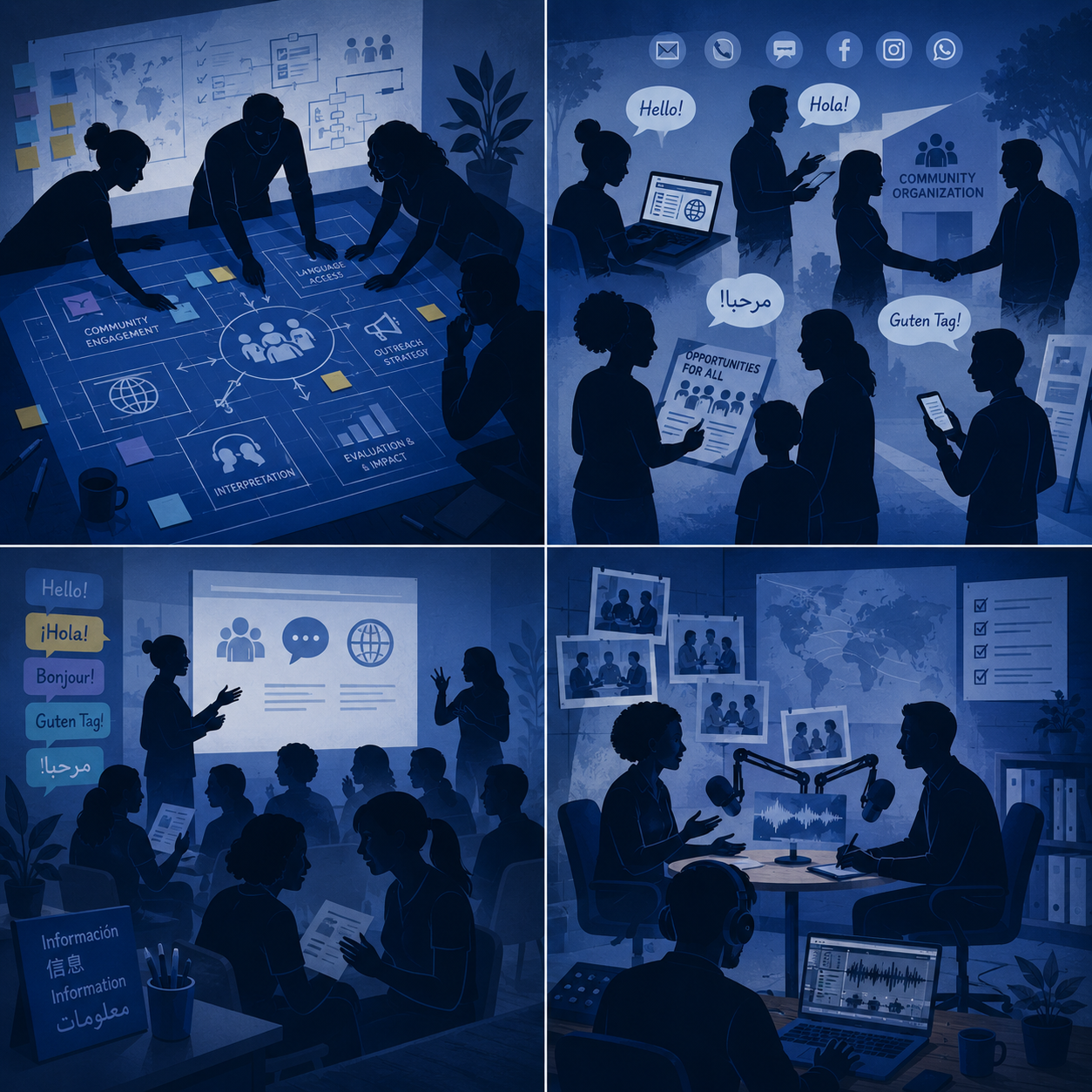
Designing with multilingual communities in mind can drastically influence everything from community partnerships and outreach strategies to participant recruitment, communication, staffing, budgeting, and evaluation. Rather than adapting programs to multilingual communities after they have been developed, organizations can create programs that recognize multilingual participation as an integral part of their design from the outset.
From Design to Implementation
Thoughtful program design establishes direction. Implementation brings that direction to life.
Even well-designed programs rely on everyday decisions that shape participant experiences. Registration processes, communications, outreach, events, instructional materials, technical assistance and support, and feedback loops all influence whether multilingual communities can meaningfully engage with a program throughout its lifecycle.
Language accessibility plays an important role during implementation by expanding opportunities for participation across languages. Interpretation, translation, multilingual communications, accessible materials, and broader multilingual engagement can help organizations reduce barriers while strengthening relationships with the communities they serve.
When that happens, implementation becomes more than delivering services, but the ongoing expression of the decisions made during program design. When language accessibility is reflected consistently throughout implementation, multilingual communities are better positioned not only to participate but to fully engage with the opportunities a program is intended to provide.
Organizational Capacity for Multilingual Programming
The quality of multilingual programming is shaped not only by what organizations offer, but by the capacity they develop to deliver it.
That capacity extends beyond individual language proficiency alone. It reflects the people, relationships, knowledge, and organizational practices that collectively support multilingual communities over time.
For many organizations, this capacity is built gradually. Multilingual employees are recruited into key roles. Staff members strengthen their language proficiency through professional development. Community partnerships deepen. Language access responsibilities become more clearly defined. Organizational knowledge expands with each program, initiative, and community engagement effort.
These investments contribute to an organization’s ability to design, implement, evaluate, and continuously strengthen multilingual programming. As capacity grows, multilingual considerations become increasingly embedded across teams, departments, and organizational decision-making.
In this way, multilingual programming is supported not only by individual staff members but by the broader organizational environment in which they operate.
Language Accessibility and Language Transformation in Practice
At The Multilingual Project, we believe multilingual programming is one of the best use-cases of incorporating principles of Language Accessibility and Language Transformation into organizational efforts.
Language accessibility expands opportunities for participation by reducing barriers across languages. Language Transformation extends beyond individual accessibility efforts and reflects how programs evolve through language over time.
As multilingual considerations become increasingly reflected in program design, staffing, communications, partnerships, leadership, evaluation, and organizational systems, language begins influencing how programs themselves are developed and sustained.
Over time, those experiences influence future program design, implementation, and organizational decision-making, creating conditions through which multilingual programming can continue evolving alongside the communities it serves.
Recognizing Existing Multilingual Strengths
Not every organization begins its multilingual journey from the same place.
Many have already incorporated multilingual practices into their programming without necessarily viewing those efforts as part of a broader organizational evolution.
An organization may recruit multilingual staff to better support participants, offer proficiency-based bonus compensation, establish partnerships with multilingual community organizations, provide translated materials, incorporate interpretation into events, or collect participants’ preferred languages during registration.
Viewed independently, each initiative addresses a particular need.
Viewed collectively, they reveal something larger: how language has begun influencing organizational systems, people, and processes through programming itself.
Recognizing these existing strengths can be just as important as identifying opportunities for future growth. It provides organizations with a clearer understanding of the multilingual capacity they have already developed while helping illuminate how those individual efforts contribute to broader organizational Language Transformation.
Showcasing Multilingual Programming with The Multilingual Project
Organizations interested in strengthening multilingual programming do not have to undertake that work alone.
Through research, advocacy, strategic communications, ecosystem engagement, and thought leadership, The Multilingual Project helps organizations recognize existing multilingual strengths while identifying new opportunities for language accessibility and Language Transformation.
Together, we’re building a stronger multilingual ecosystem by supporting the programs, people, and organizations helping multilingual communities thrive. Beyond Words, Into Worlds.
The Multilingual Project (TMP) is a nonpartisan, multimedia research and advocacy organization on a mission to create a more robust and responsive multilingual education system.