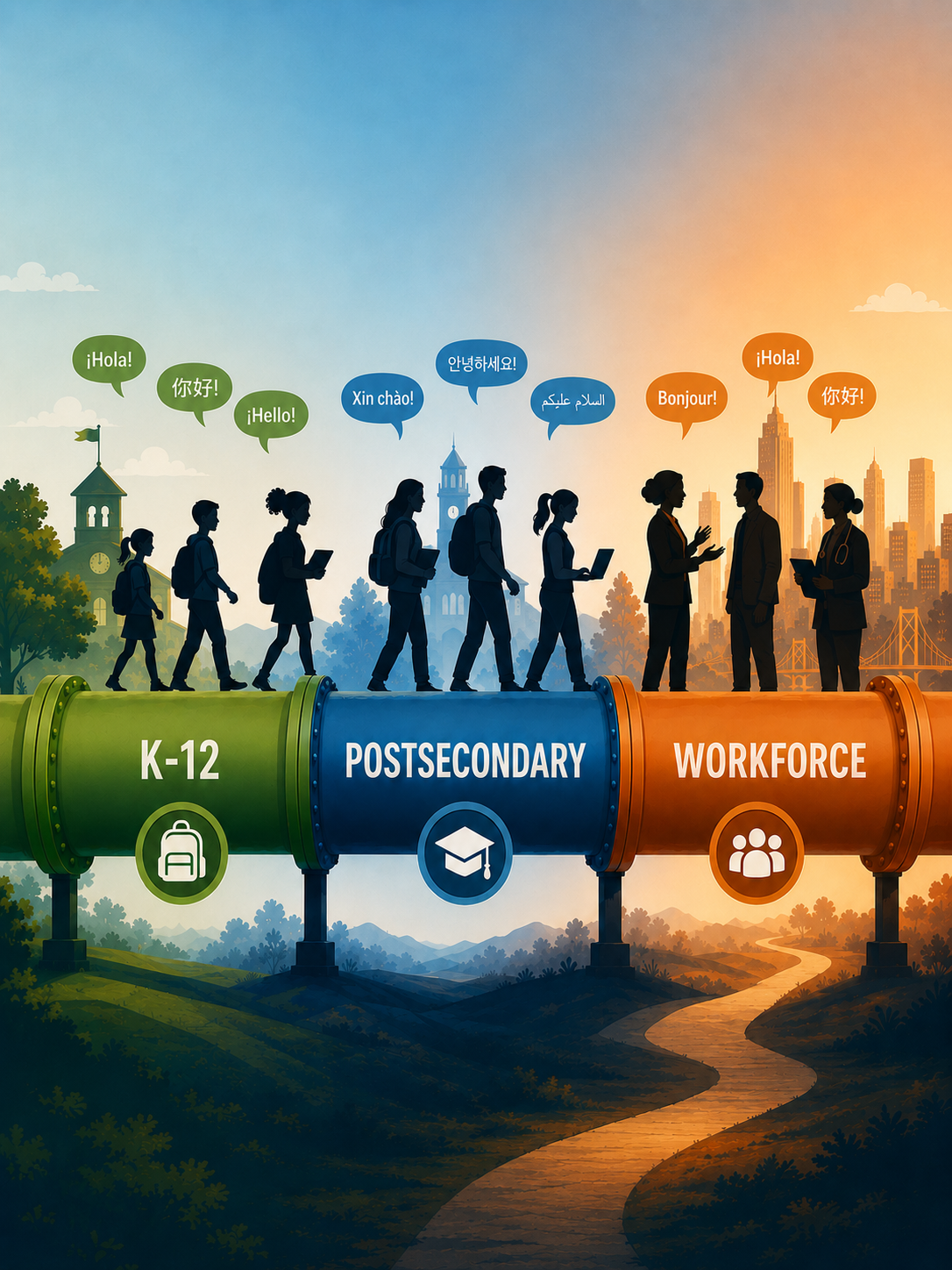
For years, conversations surrounding multilingualism and workforce development have largely operated on parallel tracks.
One focused on language acquisition and accessibility, academic achievement, and multilingual learner outcomes. The other focused on labor shortages, credential attainment, industry demand, workforce readiness, and economic mobility.
Increasingly, those conversations are beginning to intersect.
Colorado’s recent workforce agenda reflects a growing interest in how talent is cultivated over time. Policymakers, educational institutions, employers, and workforce leaders are paying closer attention to the pathways that shape workforce participation long before an individual applies for a job. Career-connected learning, apprenticeships, postsecondary credential attainment, and workforce alignment initiatives all reflect this broader shift.
The 2026 legislative session accelerated those efforts. Through HB26-1317, “Unified Postsecondary Talent Development System” (Reps. McCluskie, Taggart; Sens. Bridges, Frizell), state leaders initiated a transition process toward a unified Postsecondary and Workforce Talent Agency, signaling a growing emphasis on workforce development as a connected system rather than a collection of disparate programs.
For multilingual learners, this shift arrives at an interesting moment. Colorado has spent decades building systems designed to support language development, language acquisition, and multilingual achievement. At the same time, employers across healthcare, education, public service, and other sectors continue seeking workers capable of communicating across languages and cultures. As workforce conversations become increasingly focused on talent development, multilingualism occupies a unique position between the state’s educational priorities and its economic needs.
A Skill Unlike Others
Most workforce competencies are developed with a profession already in mind.
Students pursuing nursing prepare for healthcare careers. Future educators prepare for classrooms. Apprentices develop technical expertise tied to specific industries and occupations. The pathway is often visible from the beginning.
A student may spend years developing multilingual skills without any certainty regarding where—or whether—those skills will be applied professionally. For some learners, those skills develop primarily through formal education. For others, they emerge through family, community, culture, and lived experience.
This distinction explains why multilingual talent occupies a somewhat unusual position within workforce conversations: Colorado’s schools routinely produce students with advanced language skills, yet multilingualism itself does not always point toward a specific occupation in the same way that other workforce credentials do.
Instead, multilingualism functions differently. It travels across industries, professions, and sectors, attaching itself to a wide range of workforce needs rather than a single career pathway.
Where Pathways Begin to Form
In recent years, Colorado has invested heavily in more formal mechanisms for recognizing multilingual talent.
The Seal of Biliteracy serves as one of the most visible examples. By recognizing proficiency in English and at least one additional language, the credential provides students with formal recognition of a skill that often takes years to develop.
Denver Public Schools, for example, explicitly identifies workforce readiness and employer recognition among the program’s intended outcomes—positioning multilingualism as a skill extending beyond academic achievement alone.
As students move into postsecondary education, opportunities for specialization begin to emerge. At CU Denver, for example, the Spanish for the Health Professions Certificate combines language proficiency with healthcare communication, medical terminology, cultural understanding, and patient interaction. Rather than treating language as a standalone competency, the program situates multilingualism within a professional context where communication directly influences outcomes.
A bilingual nurse, educator, behavioral health specialist, or public servant may share the same language skills while applying them in entirely different ways.
Community colleges occupy another important position within this landscape.
Through career and technical education (CTE) programs, short-term and non-degree credentials (NDCs), adult education initiatives, and employer partnerships, they often serve learners navigating transitions between education and employment. As Colorado continues emphasizing skills-based pathways and workforce mobility, these institutions provide additional opportunities for multilingual learners to connect language skills with occupational preparation.
A Different Way of Thinking About Talent
Workforce discussions often begin with occupations.
How many nurses are needed? How many teachers? How many technicians, counselors, or public servants?
Multilingualism encourages a slightly different perspective.
Rather than beginning with a specific profession, it begins with a competency that carries value across many professions simultaneously. A single language skill may appear in healthcare, education, workforce development, government, community engagement, and countless other settings.
This reality creates opportunities that traditional workforce conversations don’t always capture.
Few workforce competencies move through as many systems as multilingualism. Language skills may be developed in homes and communities, recognized in K-12 education, refined through postsecondary study, and ultimately applied in professions that extend far beyond language education itself. Long before those skills reach the workforce, they have already moved through multiple institutions, sectors, and stages of development.
As Colorado continues refining its broader approach to talent development, multilingualism offers a useful reminder that workforce preparation does not always begin with workforce systems. Sometimes it begins years earlier, in classrooms, homes, and communities, long before a career pathway fully comes into view.
Looking Ahead
Colorado’s workforce conversations increasingly emphasize connection. Connection between education and employment. Between credentials and careers. Between talent development and economic opportunity.
Multilingual learners already move through each of those spaces.
They develop language skills, earn credentials, pursue postsecondary opportunities, and enter professions where communication carries meaningful value. What remains less clear is how intentionally those experiences connect along the way.
The state already possesses many of the components associated with multilingual talent development: language learning opportunities, multilingual credentials, postsecondary specialization, workforce training programs, and growing employer demand. The opportunity moving forward lies in understanding how those components connect—and how multilingual learners move between them over time.
The Multilingual Project is a nonpartisan, multimedia research and advocacy organization on a mission to create a more robust and responsive multilingual education system.