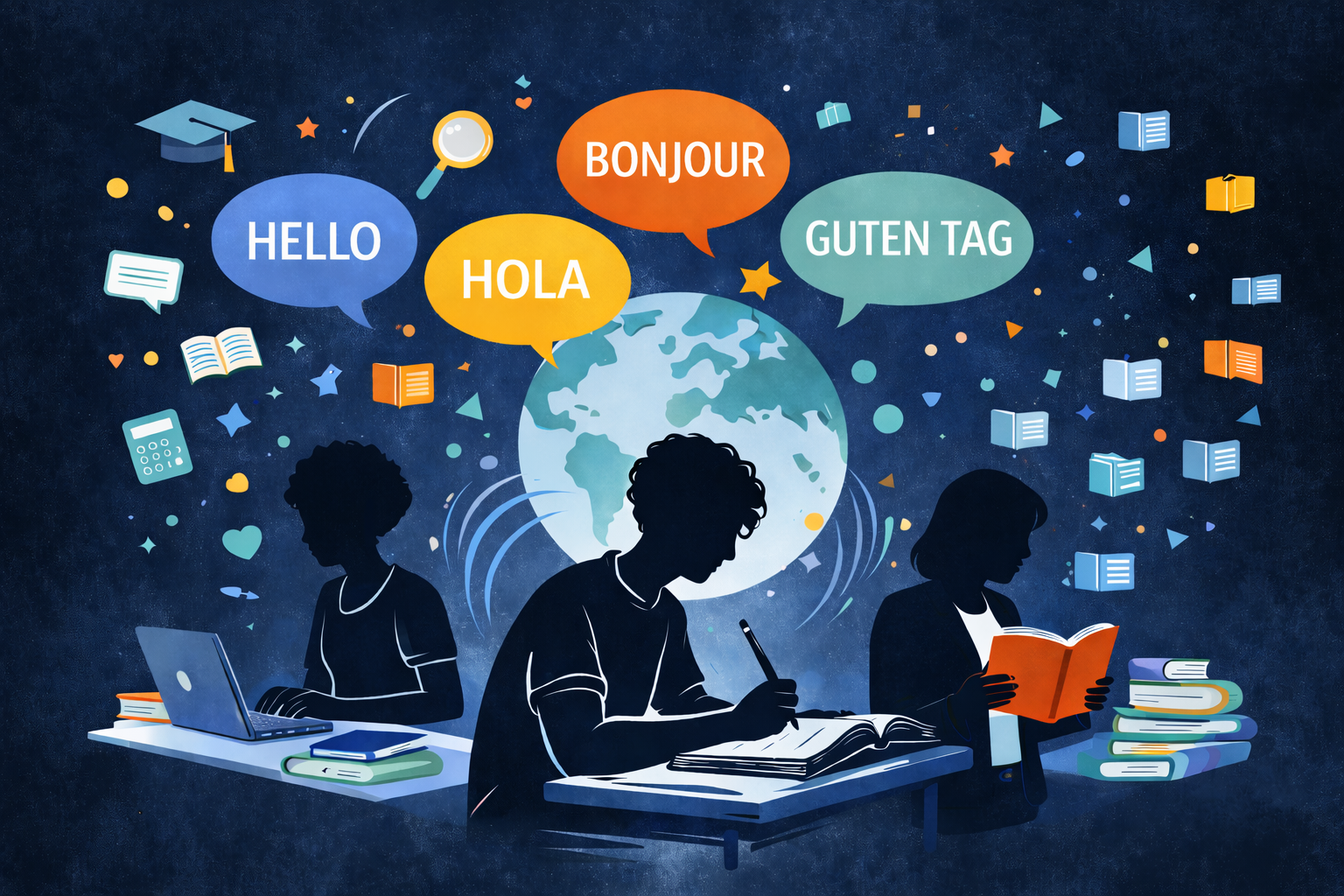
Language, Belonging, & The Multilingual Learner Experience
There’s a certain sense of belonging that returns to Heritage Learners (HLs) in a language classroom centered on their development.
For years now, language education has largely aligned with standards that prefer the prestige variety. And for good reason: from Second Language Learners (L2s) to HLs to Native Speakers alike, students must be able to employ a level of language use appropriate to business and professional contexts. So… why not exclusively focus on the prestige variety? If the goal is to prepare students for a multilingual-ready workforce, isn’t that a good thing?
Well, no… not entirely, at least. Heritage Learners in particular have needs that extend beyond the status quo of traditional language education systems. For these learners, defined in our Multilingual Learner Continuum (ML Continuum) as students who are raised in the United States with a cultural connection to a non-English language outside of school, the legitimization, validation, and reward for continued use of home and non-traditional language varieties is meaningful to a comprehensive learner experience.
What is Heritage Language Education (HLE)?
And Heritage Language Education (HLE) facilitates just that. As a method of instruction rooted in helping learners regain, develop, or maintain their heritage language, its importance is rooted in something that mainstream language education doesn’t always offer them: reconnection with their roots, their communities, and perhaps most impressively, themselves.
In Colorado and across the country, multilingual learners face immense challenges in pursuing, participating in, and completing their education. From a lack of robust and systematized language accessibility to the scrutiny facing multilingualism in the United States, MLs are performing disproportionately worse across subject areas than their monolingual counterparts. Evident by the state’s 2025 CMAS results (statewide standardized tests), multilingual learners require new, innovative, and effective interventions for their long-term academic success.
At The Multilingual Project, a key pillar of our advocacy agenda is promoting a holistic language education for the entire continuum of multilingual learners. At its core, HLE is a unique catalyst for heritage learners’ growth—linguistically, personally, and academically. When students feel a sense of belonging, operationalized through interrogating negative self-concepts about their language, engaging in service learning opportunities in their communities, and undergoing language maintenance, they’re able to reframe their relationship with language itself—shifting from hesitation to ownership, from shame to celebration, and from fragmentation to continuity across the spaces they inhabit.
HLE in Perspective
In this way, Heritage Language Education is not simply about supporting language development—it is about restoring alignment. Alignment between the language learners bring with them and the systems designed to serve them. Alignment between identity and instruction. Between community and classroom.
When that alignment begins to take shape, the impact of HLE extends beyond the classroom itself. What starts as a shift in belonging becomes a shift in access—where heritage language is no longer confined to informal spaces, but carried into postsecondary pathways and workforce systems in ways that are visible, valued, and applied. In practice, this looks like:
- Community-based and service learning opportunities that position HLs as contributors within their own communities.
- Work-based learning experiences where heritage language use is not only present, but valued and expected.
At the same time, this alignment allows for continuity in how language is developed. Rather than replacing the language HLs bring with them, HLE creates space for it to evolve alongside academic and professional registers, rather than in opposition to them. In institutions of higher education, this is exemplified by:
- Learning environments where informal and academic language use coexist, rather than compete
- Curriculum that incorporates culturally relevant texts, media, and discourse reflective of learners’ lived experiences
And perhaps most critically, HLE creates space to dismantle the negative self-beliefs that many Heritage Learners carry about their language—beliefs shaped by years of correction, comparison, and implicit messaging about what “counts” as legitimate language use. In doing so, it repositions learners not as deficient, but as already multilingual individuals refining their capacity, exemplified by instruction that directly addresses stigma around accents, dialects, and non-standard forms, learning environments that validate lived linguistic experiences as legitimate and valuable forms of knowledge, and increased confidence, participation, and engagement that translate into broader academic growth across subject areas.
The Path Forward
Heritage Language Education does more than support language development. It restores alignment between identity and instruction, between community and classroom, and between the language learners bring with them and the systems designed to serve them.
For Heritage Learners, that alignment is not supplemental. It is foundational.
And to build a multilingual education system that is truly robust and responsive, HLE cannot remain adjacent to language education—it must be embedded within it. Intentionally, consistently, and with the same level of rigor, recognition, and investment afforded to traditional language education systems. Beyond words and into worlds.
The Multilingual Project is a nonpartisan, multimedia research, advocacy, and translation company on a mission to create a more robust and responsive multilingual education system.