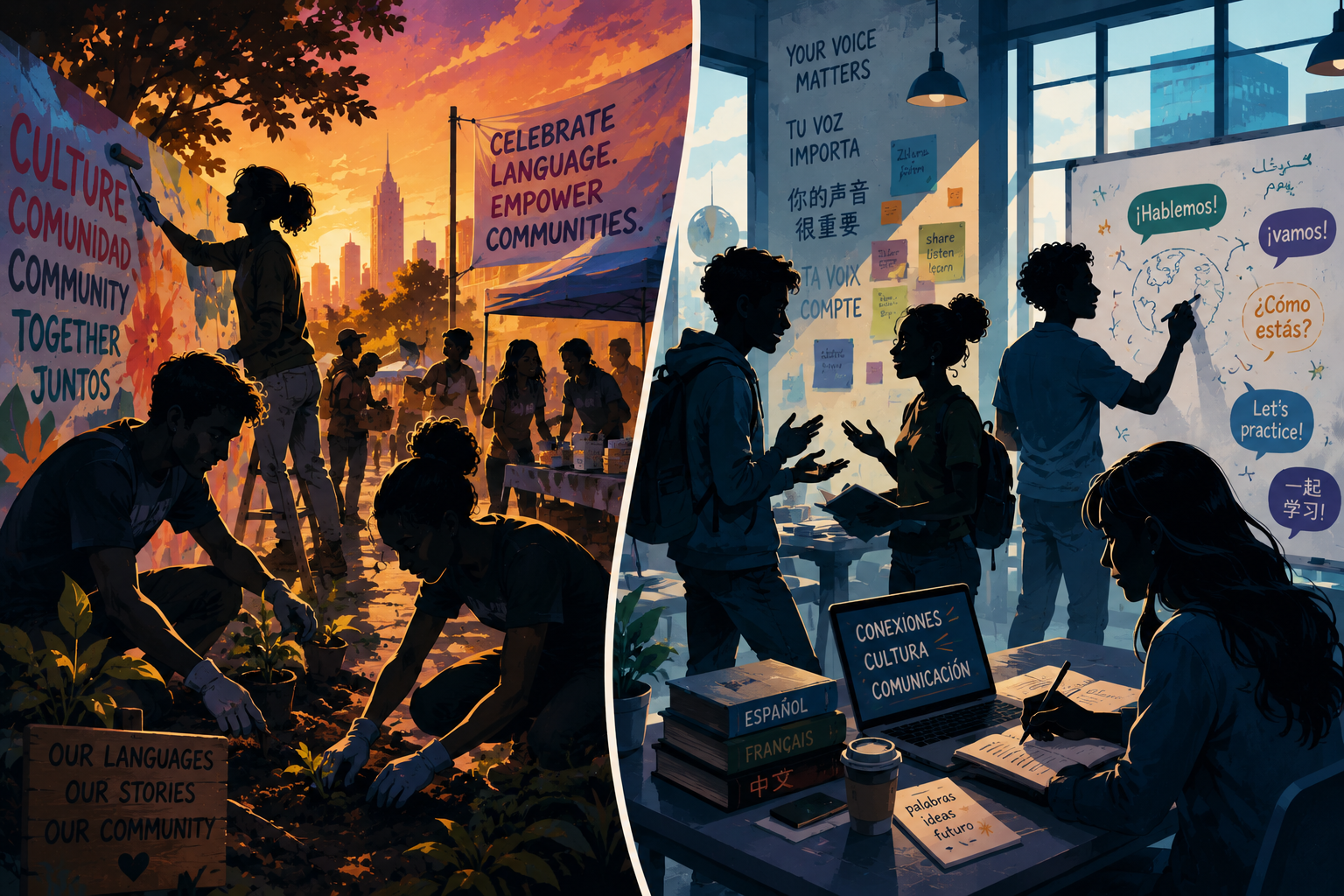
It’s often said that multilingualism—in its purest form—is an experience with the self, with others, and with the self in relation to others. That through language learning—and language living—two seemingly distinct stories and perspectives, two different lives, are not so different after all. And that perhaps, in where they do differ, there exists an opportunity to better understand how language shapes the ways each of us experiences and interprets the world.
At The Multilingual Project, we recognize multilingual learners (MLs) across a continuum representing Second Language Learners (L2s), Heritage Learners (HLs), and Native Speakers (NS) alike. When MLs are brought together through language, spaces begin to emerge where communication, identity, culture, and lived experience are shared meaningfully.
Empowering Language Learners Through Community
But this is said often. That community is the secret to joy among multilingual learners. That sharing identity and culture in spaces beyond classroom walls improves academic and social outcomes alike.
And the research supports this. Studies show that when MLs engage in afterschool programming, for example, they are likely to experience stronger language development, greater mutual respect and understanding, and an overall boost in academic performance.
So then, if multilingual spaces are continuously associated with such outcomes, what might become possible if multilingual learners had greater access to these environments more broadly? If institutions invested in and strategically supported their infrastructure?
A Local Example: Spanish and Linguistics Student Association (SALSA) at CU Denver
Enter the Spanish and Linguistics Student Association (SALSA) at CU Denver: a student-led organization dedicated to promoting Spanish language education and multilingualism within the university and its surrounding communities.
According to its mission statement, SALSA fosters interest in languages and multilingual culture, supports professional development for multilingual students, and engages in meaningful collaborations with Spanish-speaking and other communities to explore language and cultural appreciation.
And SALSA’s methods have gotten results. In partnership with leadership from the Department of Modern Languages (DOML), the student organization—grounded in supporting multilingual learners of all languages and backgrounds—has emerged as a high-quality intervention to declining enrollment and established greater community among language students at the university. In this way, SALSA and CU Denver have created more than a “multilingual space,” but strategic infrastructure for postsecondary multilingual l/earners.
Supporting Multilingual Learner Infrastructure: Beyond Words, Into Worlds
What SALSA ultimately demonstrates is that multilingual spaces do not simply emerge on their own. They are built. Sustained. Invested in. And when they are, multilingual learners are given something larger than additional opportunities to practice language alone: they are given opportunities to belong within it. To encounter different perspectives, lived experiences, and relationships to language in real time and in community with others.
To that extent, supporting multilingual learners may require more than expanding access to language instruction itself, but investing more intentionally in the multilingual spaces where language, identity, culture, and human connection are able to coexist meaningfully. Beyond Words, Into Worlds.